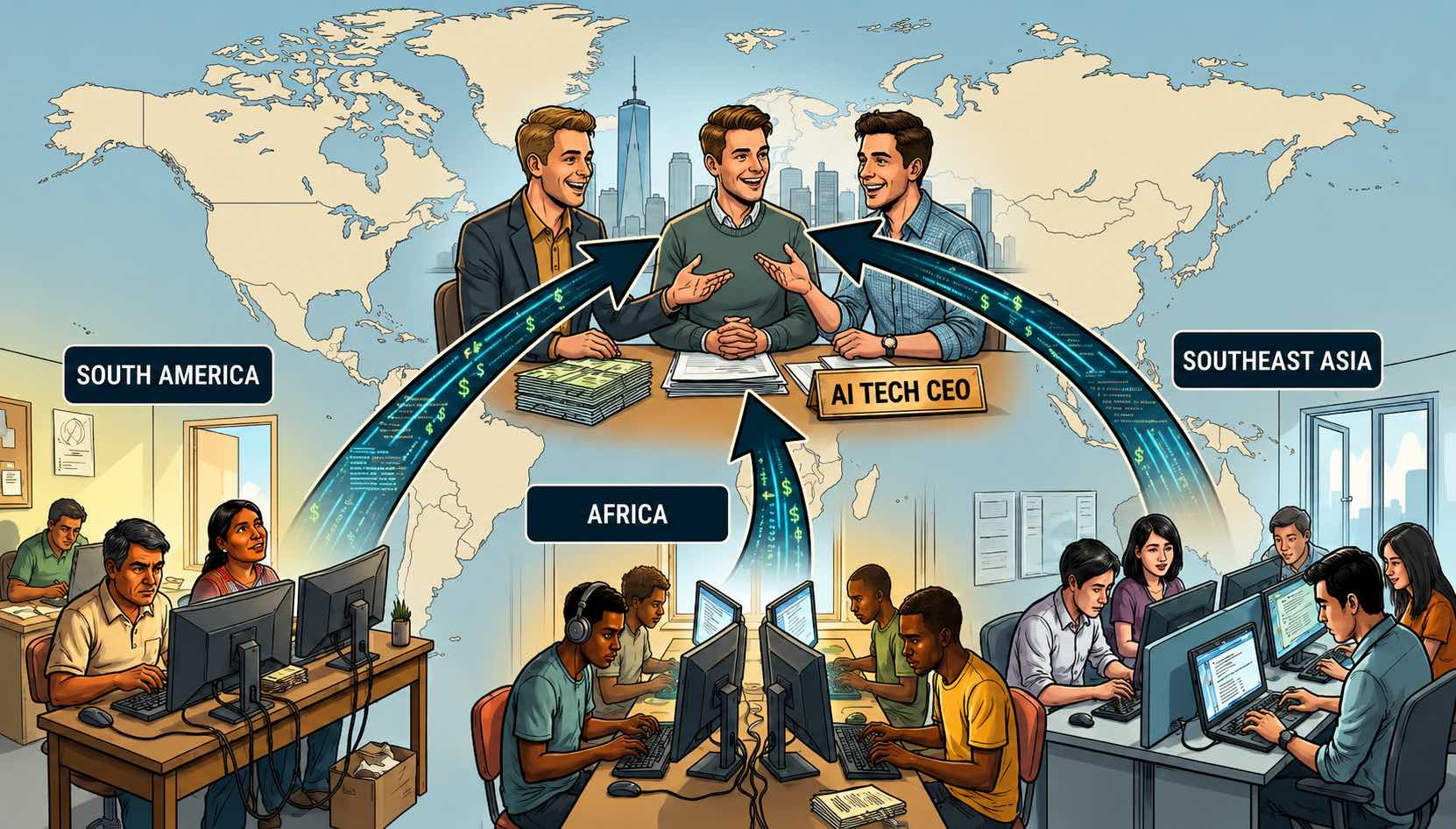
AI companies in the U.S. once claimed to have been founded on humanitarian principles like finding cures for cancer or solving the global climate crisis. Instead, companies developed free search-engine-like models while attempting to hide their use of exploited workers. Scholars point out parallels between the AI industry and colonialism, and define this phenomenon as technocolonialism. Technocolonialism describes how data, infrastructure, and tech dependency are dominated by the Global North. As U.S. CEOs convey an image of progress, they actually replicate historical labor abuses and resource exploitation.
Artificial Intelligence Fully Reliant on Human Intelligence
Each day brings to light more stories of human labor exploitation by billion-dollar AI companies that falsely market new models as “self-learning” when in fact they are developed by workers in Africa, Asia, and South America. One more extreme example involves the UK-based company builder.ai, which was actually not an AI at all, but rather hundreds of Indian contractors fulfilling prompts. Such companies marketing their AI as non-human intelligence discredits years of underpaid human work and human intelligence, a continuation of colonialist racialized labor hierarchies.

Various titles for behind-the-scenes workers in the AI field
Credit: AWU-CWA, TechEquity via Communications Workers of America
Undervaluing Labor, Underpaying Laborers
Big companies purposely target workers in the Global South as a source of cheap labor. The 2014 economic crisis in Venezuela created the perfect conditions to enable large corporations to take advantage of Venezuela’s developed infrastructure, hyperinflation, and shortages of goods and jobs. AI data-labeling companies that contract with the likes of Google and Meta exploited hundreds of thousands of skilled Venezuelans to do the invisible labor of building AI services for only a few cents of compensation.
Similar conditions across Nigeria, South Africa, and Kenya have empowered companies like OpenAI to outsource the training of new Large Language Models (LLMs) to African gig workers. Marketing for these new LLM models presents them as developing autonomously from prior models. In reality, new models evolve through African workers’ efforts to refine answers, correct errors, and shape how the LLMs respond to prompts. In return, these critical workers are paid extremely low wages, treated as disposable, and their part in LLM development is obscured. Even worse, because their communication style, which is shaped by years of traditional British English education, is used to train these LLMs, it has come to be seen as a marker of fake or AI writing by users in the Global North.
Learning about these disparities while LLMs are free to download and AI companies achieve billion-dollar valuations is jarring. Due to wide geographic separation and the digital nature of AI, this “black box of power” works to hide the human suffering behind these services and exclude the workers from the credit they deserve and the wealth they generate.
Building an Equitable Society Means Rejecting Corporate Colonialism
Those working inside have bravely spoken out to make their work more visible. To combat technocolonialism, many initiatives are being taken across the United States. Grassroots protests have been successful in halting construction on additional data centers. The prominent AFL-CIO labor union has called for stricter labor laws to protect those working in AI, among other demands. The Algorithmic Justice League reports AI harms and injustices, while supporting productive, benevolent uses of AI. People have strength in numbers, so we must unite to stop the exploitation of the workers who build the tools we use every day. That must mean boycotting these companies and services and instead shifting our support to those who use AI for genuinely good missions.

This article was written by a guest contributor, S. Jarvis.

Learn from real business case samples and empower your organization with DEI strategies. Visit our About Us page to explore further.