
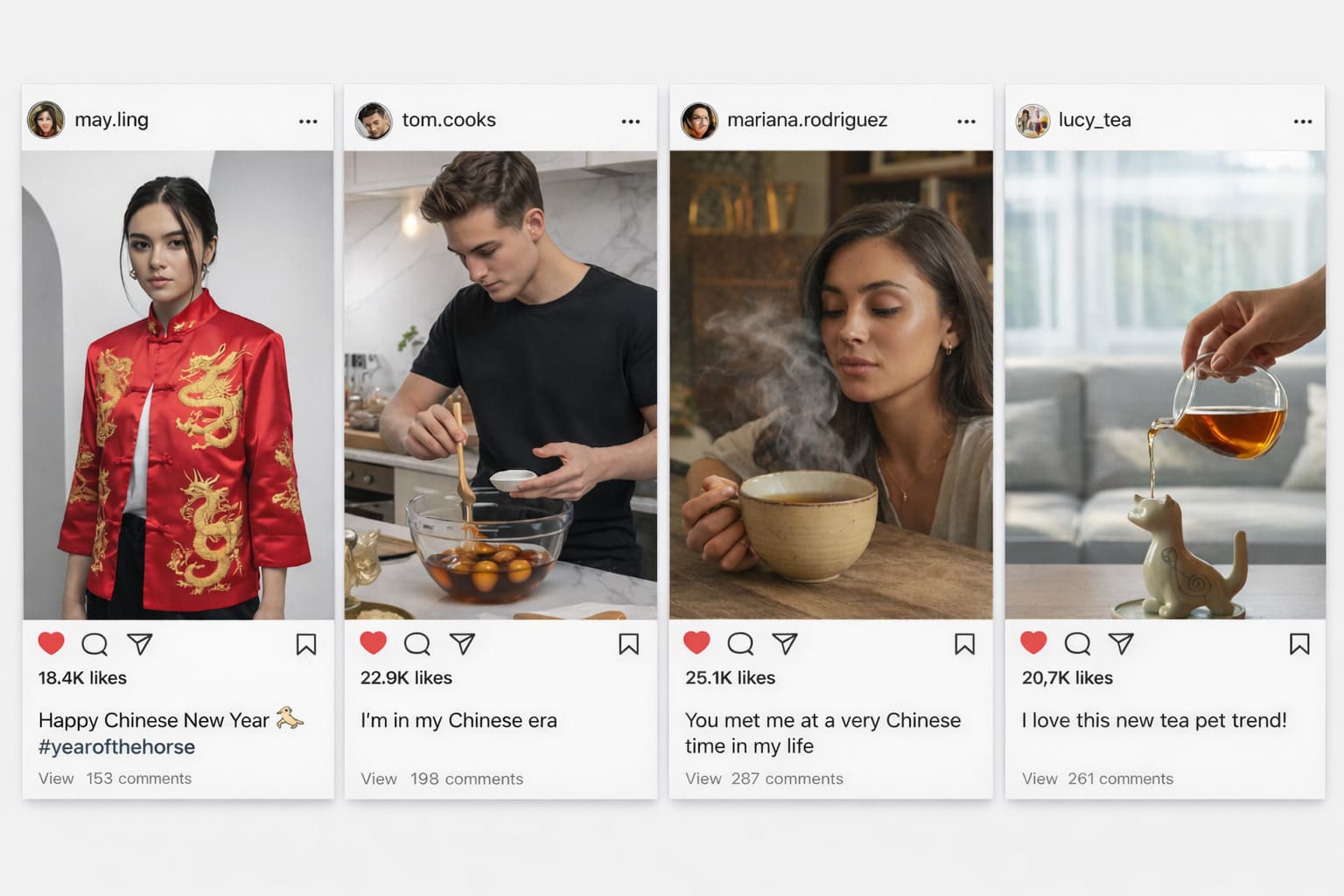
Somewhere between a TikTok audio and a lifestyle rebrand, Chinese culture became the internet’s newest aesthetic. “I’m in a very Chinese time of my life” is now circulating on the internet as the trendiest catchphrase going into the Year of the Horse. The tone is often playful, curious, even affectionate, but quickly evokes a deeper question: what does it mean to celebrate a culture while the people behind it remain unseen?
Seeing A Side of China that was Unfamiliar, but Not Alien
This moment didn’t come out of nowhere. When TikTok was briefly banned in the U.S. in early 2025, American users migrated to its competitor Xiaohongshu (RedNote). For the first time, they encountered Chinese culture completely outside a Western editorial lens. Disillusioned with rising costs, political dysfunction, and a fraying social contract at home, many Americans found themselves looking at Chinese daily life with genuine envy.
This interaction opened the door for curiosity. However, much of the recent enthusiasm is less “pro-China” and more about being “anti-America.” Chinese culture is not being embraced for what it is, but for what it isn’t. The result is a soft power aestheticization that flattens a complex country into a moodboard.
“Discovering” Another Culture’s Practices
The Tang jacket, rooted in thousands of years of Chinese dynastic history, has surged in popularity as brands like Adidas and Rohé have adopted it into their collections. Yet, minimal acknowledgement is given to its origins, even often mislabeling it as the “Mandarin jacket”. On the other side of social media, soy-marinated eggs went viral following a TikTok by Courtney Cook. Despite Courtney paying homage to the culture, her followers credited her for the recipe, describing the food as weird and exotic.
The pattern persists: the aesthetic gets extracted while the identity gets left behind. This cultural appropriation is harmful not because sharing culture is wrong, but because it rewards the borrower while erasing the source. Centuries of tradition get packaged into a tasty, fashionable trend—consumed, digested, and forgotten.

Number of Anti-Asian Attacks (1990 – 2021)
Credit: Development Services Group, CC-BY-ND, via The Conversation
Accepting Things and Traditions, but Rejecting the People
This trend comes with a sting as Asians in the West navigate harmful stereotypes. Lunchbox shaming is a near-universal experience for Asian kids; yet, that same food, repackaged and endorsed by a non-Asian creator, becomes aspirational content. Between 2020 and 2021, anti-Asian hate crimes surged 339% in America amidst false beliefs that COVID originated from Asians’ “barbaric” food cultures. Merely five years later, the same cuisine is being celebrated as ICE terrorizes Asian immigrants. Simultaneously, Chinatowns are being gentrified out of existence. Despite the fact that their culture is trending, Asians continue to face exclusion.
In her essay, bell hooks observed that adopting pieces of a marginalized culture gives the mainstream the comfort of feeling open-minded without requiring any real change. You can be in your Chinese era despite having no Chinese friends and not participating in efforts to reduce sinophobia in your area.
As with anime fans towards Japan and K-Pop fans towards South Korea, fixation on a culture’s most digestible exports creates an over-romanticized version of a country that erases its political realities, inequalities, and people. For Chinese people, this is not an era that can be discarded when the algorithm moves on; it’s their lives and tradition. The goal was never to stop celebrating Chinese culture, but to acknowledge the people and struggles behind it, so Chinese people can stop having to earn their right to exist.

This article was written by a guest contributor, Z. Dang.

Encourage DEI in your organization with programs tailored to your needs. Find out how we can support you on your DE&I journey.


