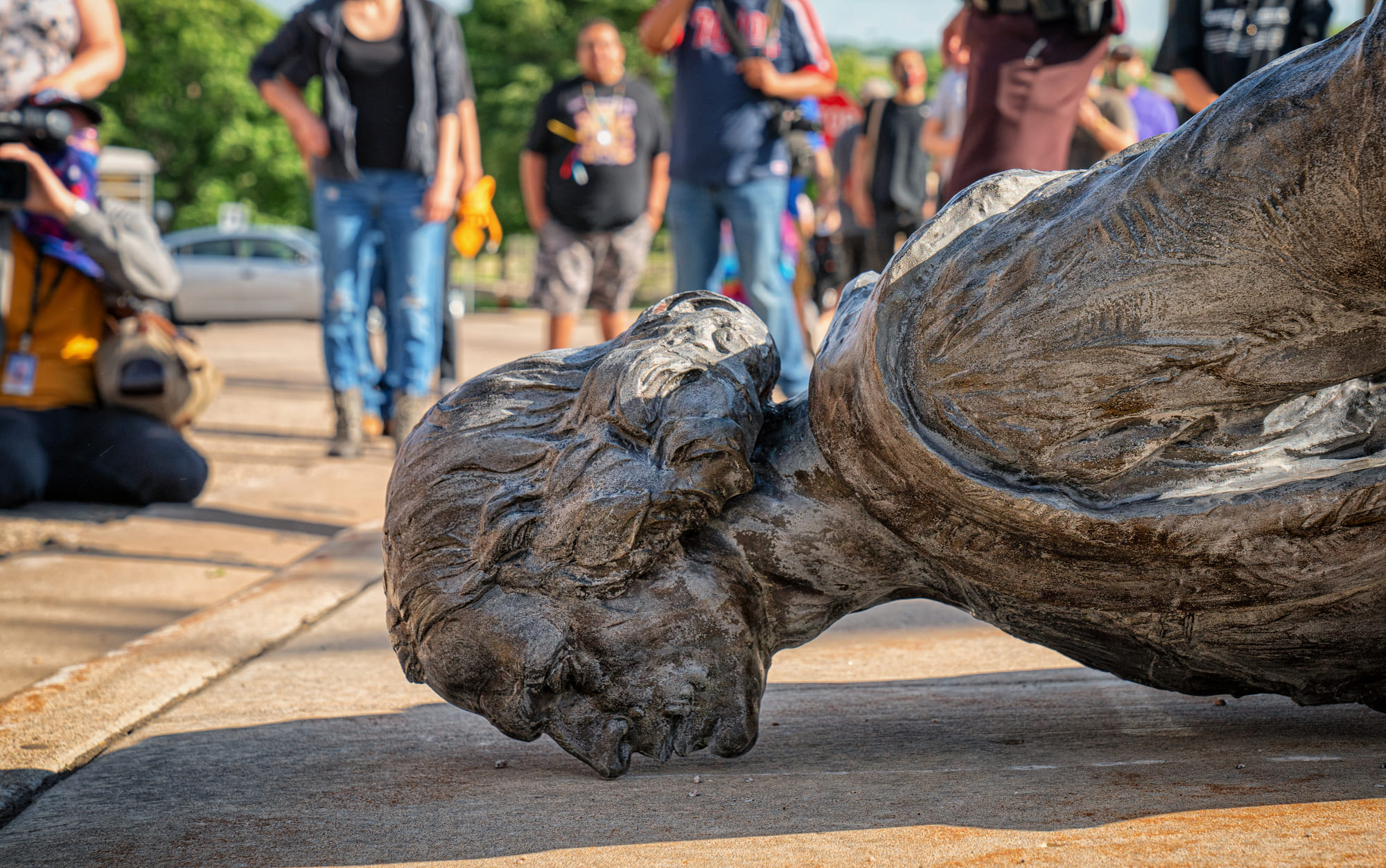
Credit: Tony Webster, CC BY 2.0, via Wikimedia Commons
On October 12, much of America commemorates the day in 1492 when Christopher Columbus arrived in the ‘New World,’ a moment that not only marked the beginning of European exploration but also led to profound disruptions, forced labor, disease, and death for Indigenous communities. Originally celebrated as a day to honor the European “discovery,” many Latin American countries have since redefined the holiday, shifting focus from Columbus to Indigenous resistance and cultural diversity. It is known as Columbus Day or Indigenous Peoples’ Day in the US, “Day of the Native Peoples and Intercultural Dialogue” in Peru, and “Cultural Diversity Day” in Argentina, amongst others.

Christopher Columbus, surrounded by a crowd of people, about to embark on his ship, August 1492
Diverging Viewpoints
This year, Latin American leaders had contrasting perspectives on the holiday. While Javier Milei (the Argentinian president) celebrated it as a date that marked “a new era of progress and civilization,” Mexico’s newly elected president, Claudia Sheinbaum, offered the opposite opinion to such sentiments, declaring, “For many years, they told us that they came from over there to civilize us. No! There were already great cultures here.” These are opinions that always divide left and right wing governments in the Americas.

Credit: Eneas De Troya, CC BY 2.0, via Wikimedia Commons
A Call to Acknowledge Historical Harms
Sheinbaum’s statement is part of a broader, ongoing dispute between Mexico and the Spanish crown. For years, Mexico’s leadership has asked for a formal apology from Spain for the killings committed during the colonial period. In return, the Spanish crown argues that modern Spain should not be held accountable for the actions of its imperial predecessors. The dispute gained renewed attention when former Mexican President Andrés Manuel López Obrador (AMLO), Sheinbaum’s predecessor, sent a letter to the Spanish government and the Vatican in 2019, asking for an apology to Indigenous communities. Spain responded by emphasizing a shared cultural heritage. Their response was that “the arrival, 500 years ago, of Spaniards to present Mexican territory cannot be judged in the light of contemporary considerations.”

Credit: Junta Informa, CC BY-SA 2.0, via Wikimedia Commons
For Sheinbaum, Those Who Refuse to Face the Past Are Not Welcome
Sheinbaum, the first woman elected president in Mexico, made her stance clear on her presidential inauguration with her decision to exclude the Spanish king Felipe VI from the ceremony. Spain’s Foreign Affairs Ministry released a statement rejecting Sheinbaum’s exclusion of the Spanish monarch from Mexico’s inaugural ceremonies, characterizing it as “unacceptable” and has stated they won’t be sending any official representatives to the inauguration. Despite this, Sheinbaum and AMLO’s administration remains firm in their request for recognition and reparations.
As October 12 continues to be observed under a variety of names across Latin America, the differences in its commemoration highlight a broader regional debate. Leaders like Sheinbaum and Milei represent opposite poles in this discussion: Sheinbaum advocates for honoring pre-colonial civilizations and confronting colonial legacies, while Milei embraces a perspective that views colonization as a necessary step toward modernity. This divide underscores a complex question for Latin America: should October 12 commemorate the arrival of European settlers, honor Indigenous resilience, or celebrate the mix of both? For Mexico’s current government, this day will likely continue to serve as a reminder of the unresolved legacy of colonialism—and the calls for reparations and acknowledgment that remain.

Encourage DEI in your organization with programs tailored to your needs. Find out how we can support you on your DE&I journey.