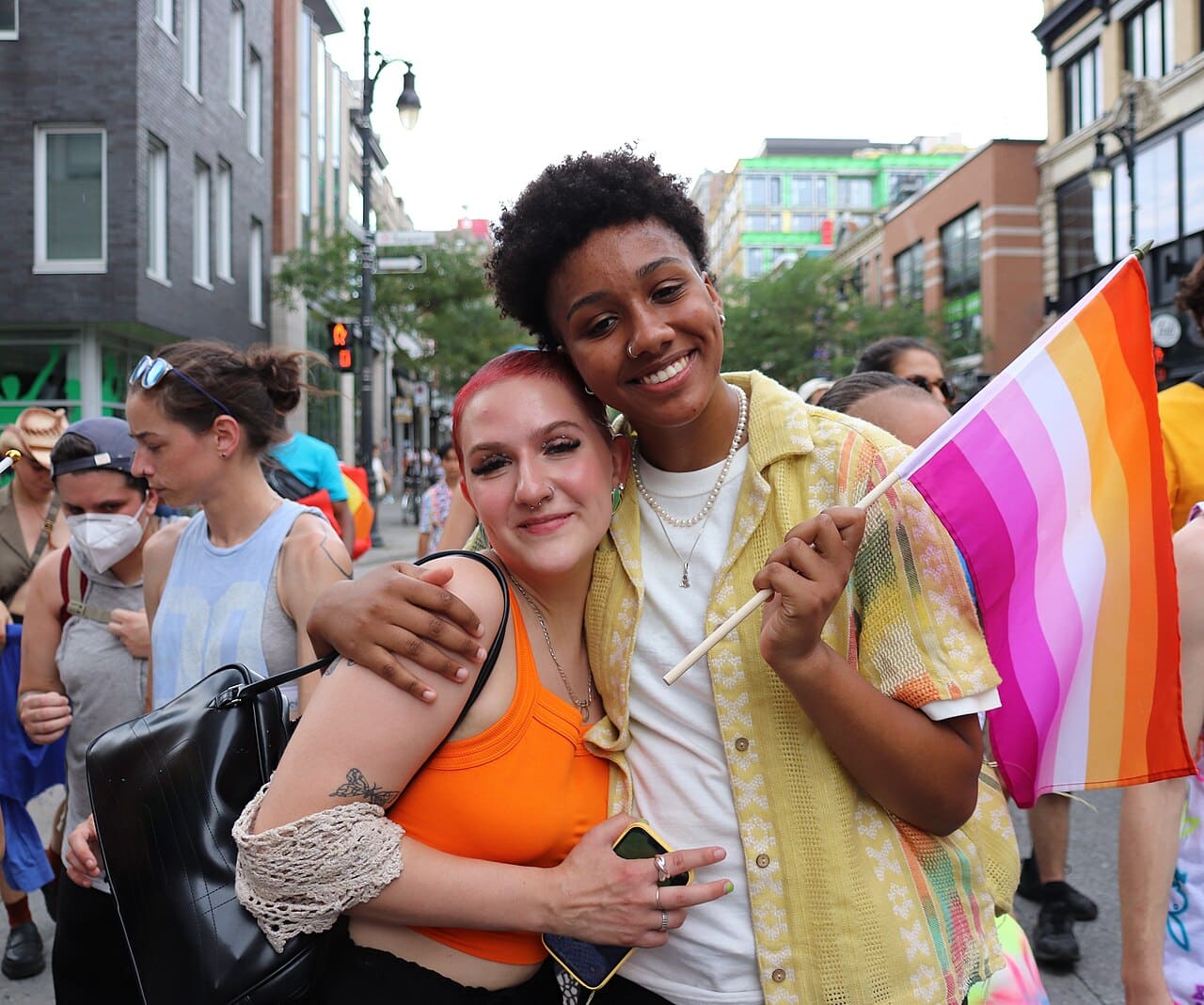
Credit: Elvert Barnes, CC BY-SA 2.0, via Wikimedia Commons
Pronouns are usually tied to a specific gender. In English, there are two standard pronouns to go with two binary genders: “she,” which is used by and for women, and “he,” which is used by and for men. For cisgender people, this is how pronouns are typically used. 36% of transgender and nonbinary people also stick to the binary pronouns, with trans women typically using she/her and trans men using he/him. However, while many people do use their pronouns to reflect their gender, it is important to understand that pronouns don’t always equal gender.
Intersections of Language, Gender, and Sexuality
The lesbian community has a complex, rich understanding of gender and, as a result, it has a history of diverse pronoun usage. He/him lesbians have been a core part of the lesbian community for generations, but the idea of a woman using he/him pronouns is hard for people to grasp at times. Some lesbians, like butch lesbians who dress in a traditionally masculine way, prefer to use more masculine pronouns or titles such as husband or boyfriend. Trans and nonbinary lesbians who feel more comfortable in their masculinity may also choose to use he/him pronouns. For many, masculine gender expression goes beyond pronouns, with some Butch, trans, or non-binary lesbians also opting for hormone therapy and top surgery.

Data via The Trevor Project
Femininity Required by Law
In the past, using he/him pronouns and masculine titles was a necessary safety measure for lesbians, especially for butch lesbians. In the 19th century, cross dressing and drag were made illegal through revived “masquerade laws.” On top of this, being gay was criminalized and socially punished. To combat this, Black Lesbians in Harlem created terms such as “mama” and “papa” to help lesbians avoid notice when discussing their relationships in public.
Stormé Delarverie, a singer and drag king from New Orleans, was a butch lesbian who worked at Jewel Box Revue. Some refer to her as the “Stonewall Lesbian”, believing they were the one who started the Stonewall Riots. After being arrested a few times by police for being a drag king, Delarverie decided to start dressing masculinely outside of performances. Delarverie used multiple pronouns, including he/him and they/them. American artist Michele Zalopany said in an interview that Delarverie didn’t really identify as anything, but had lived their life as a Black man.

Stormé Delarverie
Credit: Schomburg Digital Collections, New York Public Library Colorized by Eli Erlick, CC BY 4.0, via Wikimedia Commons
No Single Definition of “Womanhood” or “Lesbian”
Another prominent example is Leslie Feinberg, a transgender activist and writer of Stones Butch Blues. According to Them’s History on He/Him Lesbians, Leslie used neopronouns and sometimes he/him pronouns, with hir/her novel showcasing how transness and gender nonconformity fit in the lesbian community. She/zie was a theorist who advanced a Marxist concept of “transgender liberation” and had a massive cultural impact with hir/her writings, especially hir/her book “Stones Butch Blues”. Feinberg showed how gender expression and gender identity can be incredibly complex.
Lesbians have long had a history of subverting gender norms and going outside of traditional feminine gender expression. The community has long been built up by Black and/or trans lesbians and has long played with various ways of gender expression. Gender expression doesn’t always mean “women wear dresses and men wear pants”. For many lesbians, rejecting the binary has never been about rebellion but living as their authentic selves. If the majority can understand the unique way pronouns can be used, it could potentially lead to more acceptance of those who are outside the binary.

Credit: Equality Michigan via the LGBT Free Media Collective, CC BY-SA 3.0, via Wikimedia Commons

Learning Cycle promotes a variety of programs to help deepen your understanding of DE&I. If you would like to know more about us, please click on About Us.