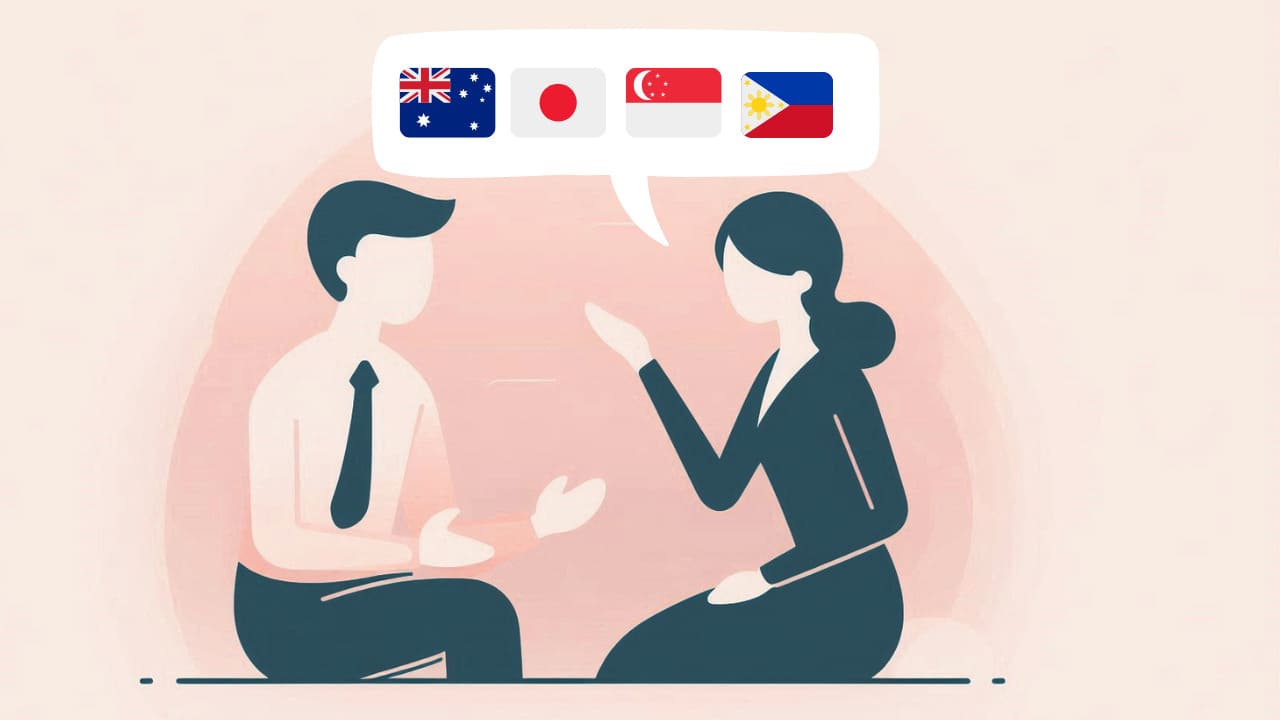
A manager recently told me, half-laughing, “Oh, you even sound more Singaporean now.” It wasn’t the first time I’d heard this. Strangely, it made me pause because it reminded me how every country I’ve lived in has left its mark on my voice. My accent changes, and people’s assumptions about who I am change as well.
Our Accents Reflect Our Experiences
After living in 4 countries so far, I have noticed how my voice instinctively shifts depending on who I am speaking to. I use international English in meetings, Filipino expressions and tones when I’m excited, and Japanese softness when I’m thinking. Now, apparently, I have a slight Singaporean cadence that seems to have appeared out of nowhere.
I’m Japanese, but I grew up in the Philippines, where English and Filipino (Tagalog) became my first languages. When I later moved to Japan, the reactions were always the same: “Your Japanese is so good!” It was meant kindly, but it stung in ways I couldn’t explain. I’d reply, “Actually… I’m Japanese,” and people would gasp and apologize, scrambling to recover. It became unintentionally comedic, but also quietly painful. I didn’t sound like what “a Japanese person” was supposed to sound like. Speech often becomes a shortcut for judging identity and belonging. I lived this phenomenon before I even had the words to describe it.
Linguistic Discrimination
Australia brought a different layer. While juggling internships and job applications, I was casually told by a hiring manager that it might be “difficult” for me to land a job. Not because of competition, but because my accent was “not Australian enough.” It was said almost offhandedly, but the message was clear. I would stick out. I wouldn’t fit the culture, and that alone would hold me back.
It was jarring. Until that moment, I had never considered my accent as something that could limit me professionally. Hearing it stated so bluntly made me feel exposed and othered in a way I wasn’t prepared for. I remember softening certain vowels afterward, trying to sound “more Australian,” even though there’s no such thing as a truly neutral accent. What I was doing, I later learned, was code-switching, or the adjustments people make in behavior, tone, and language to blend into different cultural environments. This code-switching came with its own costs: self-consciousness, emotional fatigue, and the quiet fear that authenticity might not be enough.

Accent Rating Over Time (where a higher rating means a more positive connotation)
Credit: Attitudes to Accents in Britain and Implications for Fair Access, via Accent Bias Britain
Finding My Voice
Singapore has been different. The longer I stay, the more people tell me I sound “local.” For the first time, code-switching doesn’t feel like armor. It feels like connection. Sometimes I catch myself saying things like, “Can can,” or ending sentences with a soft “lah” when chatting with colleagues. It slips out naturally, not out of fear of sticking out, but out of comfort.
My time living in 4 countries has taught me that my accent isn’t broken. It is just layered. Today, when someone points out that my accent has changed, I smile. My accent changes not out of a need to fit in, but because my experiences have woven themselves into the way I speak. Living abroad reshapes how you show up in the world, often in ways you only notice later. My accent is simply the trace of each place that has held me.

Credit: Man vyi, CC SA 1.0, via Wikimedia Commons
This article was written by a guest contributor, A. Orui.

If you are interested in diversity after reading this article, our program may be of use to you. Find more details here!