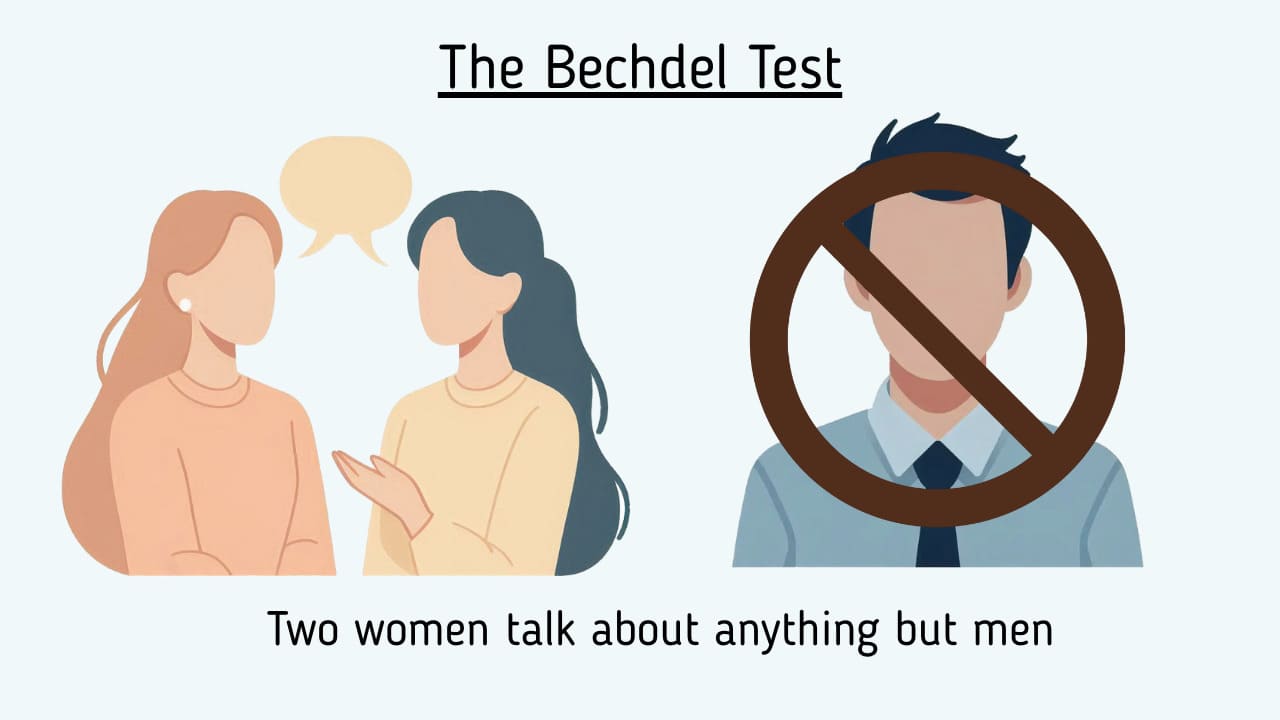
In 1985, cartoonist Alison Bechdel published a strip in her comic ”Dykes to Watch Out For” that would go on to spark decades of debate about women’s representation in media. The joke, credited to her friend Liz Wallace and rooted in Virginia Woolf’s critiques of flat female characters, was simple: a character explains she only watches a movie if it features at least two women who talk to each other about something other than a man. What began, in Bechdel’s words, as “just a little lesbian joke in an alternative feminist newspaper” has since become one of the most cited cultural benchmarks for gender representation.
These three criteria went on to form the basis of the Bechdel Test. While some sources also specify that the female characters should also be named, the test itself is largely unchanged from its original form in the comic. It is now applied across film, television, literature, and even video games as a quick, accessible way to examine women’s visibility and agency in stories.

Alison Bechdel
Credit: Chase Elliott Clark, CC BY 2.0, via Wikimedia Commons
Do Your Female Characters Exist Outside the Context of Men?
The Bechdel Test is not in itself a definitive measure of feminism, but it can serve as a litmus test for female representation. One of the most persistent misunderstandings is that passing the Bechdel Test means a work is feminist or deeply equitable. The test doesn’t measure the quality, depth, or significance of interactions from a feminist perspective. In reality, a film could pass simply by having two women briefly discuss, for example, shoes or baby names.
Conversely, failing the test doesn’t automatically mean a work is sexist. Some narratives, like those set in all-male environments or featuring a very small cast, might fail without any intent to exclude women. Likewise, because the criteria are so simple and straightforward, they can easily be “gamed” by adding token lines of dialogue that technically pass without improving overall representation.

Male vs female role representation in films
Credit: Sandstein, CC BY-SA 4.0, via Wikimedia Commons
A Real Life Test: It’s Not Easy to Avoid 50% of the Population
A writer for Hello Giggles once spent a week trying to “pass” the Bechdel Test in her everyday life, deliberately avoiding conversations about men with other women. She found it surprisingly difficult, even with close friends. The experiment underscored the difference between on-screen representation and real-world dynamics, as well as how ingrained certain conversational topics can be.
The Bechdel Test works best as an industry-level tool, offering a quick way to spot patterns across a portfolio of work. It can be a first step in evaluating scripts, content libraries, or advertising campaigns for women’s presence and agency. But to understand whether representation is meaningful, it should be paired with other measures, such as the Mako Mori Test or analysis of character arcs, leadership roles, and intersectional diversity.
Why Bother? Moving Beyond Media Archetypes
The Bechdel Test is valuable because it sparks conversations. However, real progress in representation requires going deeper and asking not only whether women are included, but also how they are portrayed, why they are there, and whether their stories carry weight.
As Bechdel herself has said, the test was never meant to be a final verdict. Passing the test is not the same as achieving equity or empowerment. Rather, it’s a reminder to look more closely at the stories we tell and the people who get to tell them.

Stay connected on your DEI journey with Learning Cycle. Explore our workshops and success stories to empower your team.