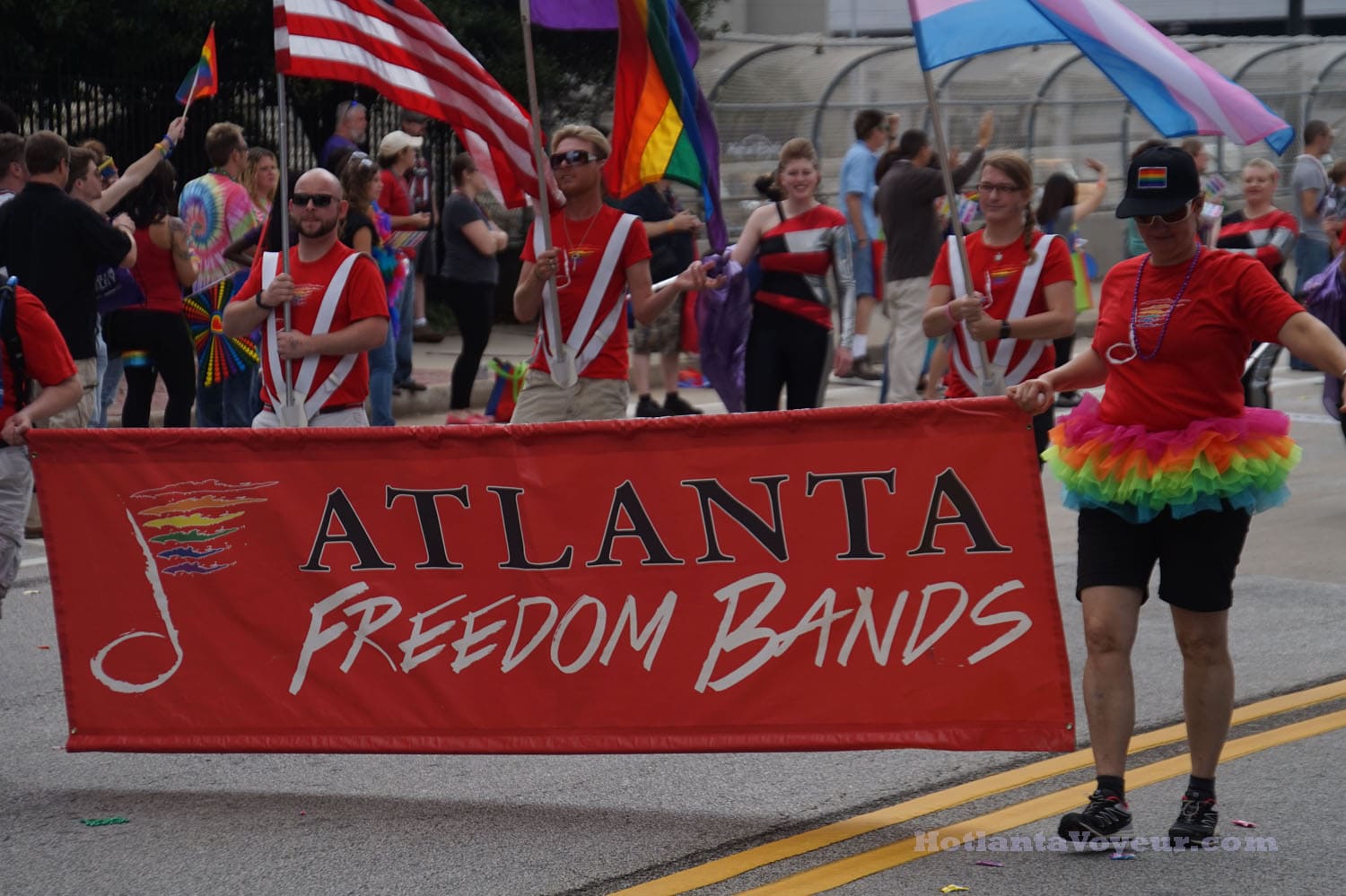
Credit: JD Harvill from Atlanta, USA, CC BY 2.0, via Wikimedia Commons
“The first Pride was a riot” is a statement I have heard many times in queer spaces, and that got me interested in queer history. As a queer person from the South, I was curious about what Pride was like. I especially wanted to see how it changed as it moved from New York down to the South.
The South’s Discriminatory Legacy
The US is a large place with different regional cultures, so progress is not linear across the country. One of the most culturally dominant regions is the South. The South has a more cultural than geographic meaning, consisting of the former slaveholding Confederate states and Texas.
The cultural influences of this Confederate history tend to result in Southern states being more openly discriminatory towards racial and sexual minorities than other states. The South’s large populations of minorities live here because they often can not or do not want to leave their homes, not because it’s a very inclusive place. Despite these legal and social challenges, many minority communities continue to exist and grow in the South, including the queer community.

The American cultural South, which is not strictly the geographical South
Credit: Wapcaplet, CC BY-SA 3.0, via Wikimedia Commons
It’s Easier to Be Gay in New York Than Georgia
Queer history in the United States tends to focus on the 1969 Stonewall Uprising in New York, when queer people fought back against a police raid. The Gay Liberation Front formed in response to the Stonewall Uprising and got to work. In 1971, the Georgia chapter organized what is widely considered the first Pride in the South, held in Atlanta. The year before, however, Atlanta had already hosted a rally on the anniversary of Stonewall. The 1971 Pride was a small event, and risky for participants fearing being socially outcast. Beryl Boykin, the marshal at Atlanta Pride that year, said they were refused permits, resulting in them having to march on the sidewalks with the ordinary pedestrians.
Most early Pride events in the South were similar to Atlanta’s, being small and unsanctioned. Despite the risks, these Pride events would continue to grow. By 1976, the crowd for Atlanta Pride had grown to over 1000 members, and other cities like New Orleans, Louisiana and Miami, Florida had begun to have Pride parades or marches.

Discomfort with LGBT people is higher among American Southerners than across the nation as a whole
Credit: LGBT Life in the South via Glaad
Greater Inclusion, Bigger Pride
During the 1980s and through the 90s, Pride in Atlanta turned into a multi-day event. The 1980s were a time of togetherness in the face of the AIDS epidemic. By the mid‑ to late‑80s, the crisis was ravaging the LGBTQ+ community, killing many and leaving countless queer people socially isolated. Participants were motivated by a desire to affirm their existence as members of the community, hitting back against a mainstream society that tried to erase and forget them. Atlanta Pride had 150,000 participants by 1994, with a lot of the focus shifting to combat the AIDS epidemic and the stigma surrounding it.
In the 2000s, Pride in Atlanta and other major cities in the South started to become what I recognise it as today: a much more mainstream event with large parades. The 2025 Atlanta Pride actually counted over 350,000 participants in the festivities. Today, Pride is celebrated in localities all over the South, and is a place where queer people and their allies can feel and celebrate queer joy and community. For this and every Pride, we should make a point to remember how we got here. LGBTQ+ people in the US continue to face oppression, making Pride in the South into a story of resilience and solidarity in the face of criminalization, health crises, and discrimination.
This article was written by a guest contributor, W. Tyson.

Ready to empower your team and organization? Explore DE&I best practices and success cases. Learn how to get started with our resources.