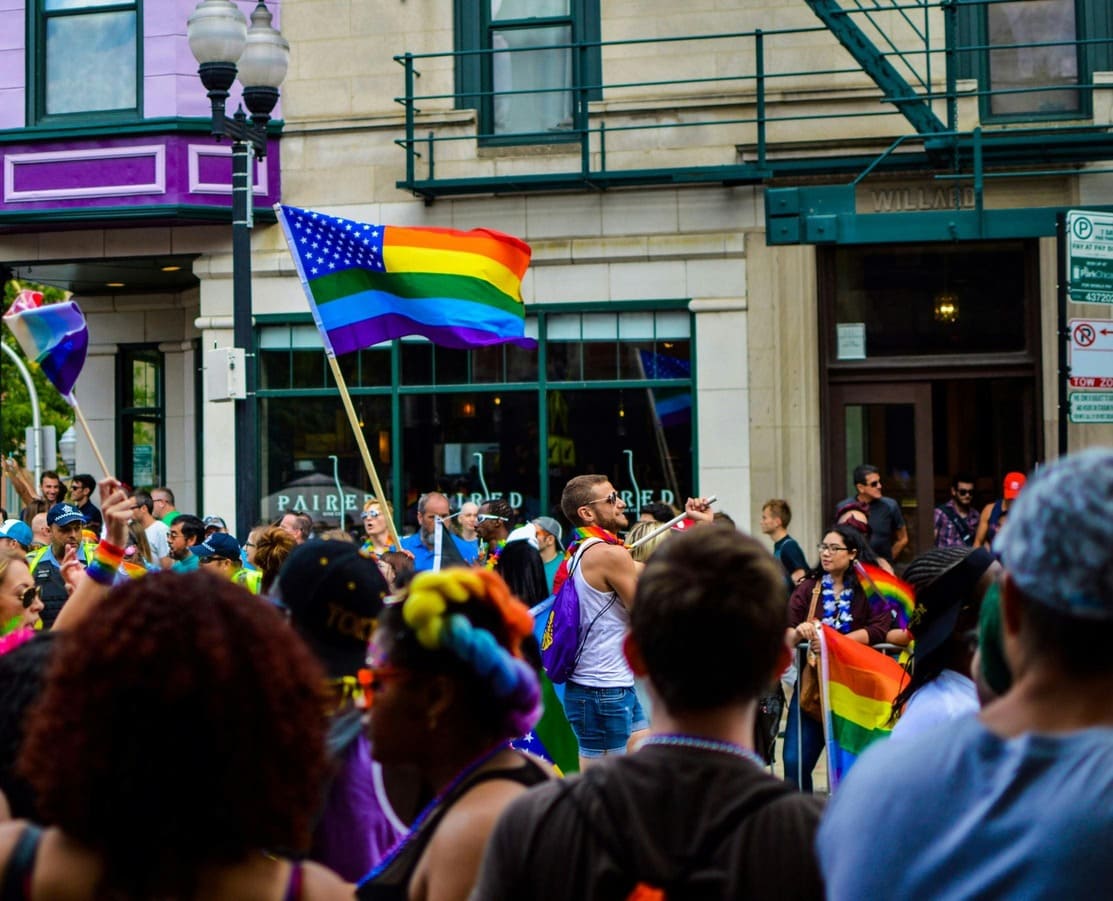
Those whose primary exposure to American culture is content produced by the US media empire could easily come to believe that the United States is a place where LGBT+ people are totally and completely accepted, with only a small minority of anti-LGBT+ individuals being few and far between. Unfortunately, that isn’t quite true.
The United States’ vast size and widely diverse local cultures have resulted in a country with fragmented and varying levels of acceptance for LGBT+. How accepted LGBT+ people are by their local communities and, in fact, how safe it is to exist openly changes with the zip code. Yes, there are certainly areas that show widespread acceptance of and even celebrate LGBT+ identities, but there are also large swaths of the country where strong disapproval, hatred, and threats of violence and death make it unsafe to be visibly non-cisgender or non-heterosexual.
Legal Milestones and Progress
That being said, in recent decades, conditions for LGBT+ Americans have undoubtedly improved. Evidence of this progress is most visible in the US Supreme Court’s 2015 ruling in the case of Obergefell vs Hodges. In this ruling, same-sex marriage was determined to be a right that was protected by the US Constitution’s Fourteenth Amendment. Essentially, this amendment dictates that the US government is not permitted to create laws and/or extend rights that apply to only one group or demographic. All people in the United States must be provided equal and fair treatment. As those in heterosexual relationships are permitted legal marriage rights, so too must those in same-sex relationships.
Fluctuating Levels of Acceptance
During this period, acceptance of those who experience same-sex attraction has fluctuated but generally trended upwards. Gallup polling reports that in May 2015, one month before the Obergefell ruling, 63% of Americans believed that gay and lesbian relations were morally acceptable, with that number rising to a peak of 71% in 2022 before declining again to 64% in 2023. This fluctuation is reportedly a consequence of the extreme polarization between political factions in the US, as allies grow more supportive and opponents grow more oppositional.
Challenges for Transgender Acceptance
The Obergefell ruling therefore legalized same-sex marriage, but it didn’t enshrine any protections into law. State and federal laws still defined marriage as a union between a man and a woman, enabling some emboldened government officials and private businesses to continue discriminating against same-sex couples. Same-sex marriage remained in this tenuous legal limbo until 2022, when the Respect for Marriage Act was signed into law. The Respect for Marriage Act ultimately redefined marriage as a union between “two individuals” and prohibited any denial of marriage rights based on “sex, race, ethnicity, or national origin.”
Acceptance of minority sexualities is becoming more mainstream in the US, but unfortunately, the same cannot be said for acceptance of transgender people, which remains rather low. The management consulting firm Gallup’s polling in 2021 shows that 46% of Americans find changing one’s gender to be morally acceptable, decreasing to 43% in 2023. Transgender adults and children, in particular, are currently in a vulnerable position, as laws have been proposed and passed in a number of states in an attempt to criminalize their existence. In the last ten years, there has been a spate of bills making it illegal to use bathrooms that do not match one’s birth sex and to provide healthcare for transgender children and adults. There have also been attempts in Florida to give the state the power to take custody of transgender children with gender-affirming parents. The US has certainly come a long way in accepting gender and sexual minorities since the Stonewall uprising of 1969 that followed a police raid on an LGBT+ community hub, but we are not out of the weeds quite yet. All LGBT+ people and allies must remain vigilant and continue to actively oppose any and all attempts to reverse the progress and growth that society has achieved over the last 55 years.

Everyone is welcome! We offer DEI programs tailored to meet the needs of all experience levels—find out more about our workshops here.