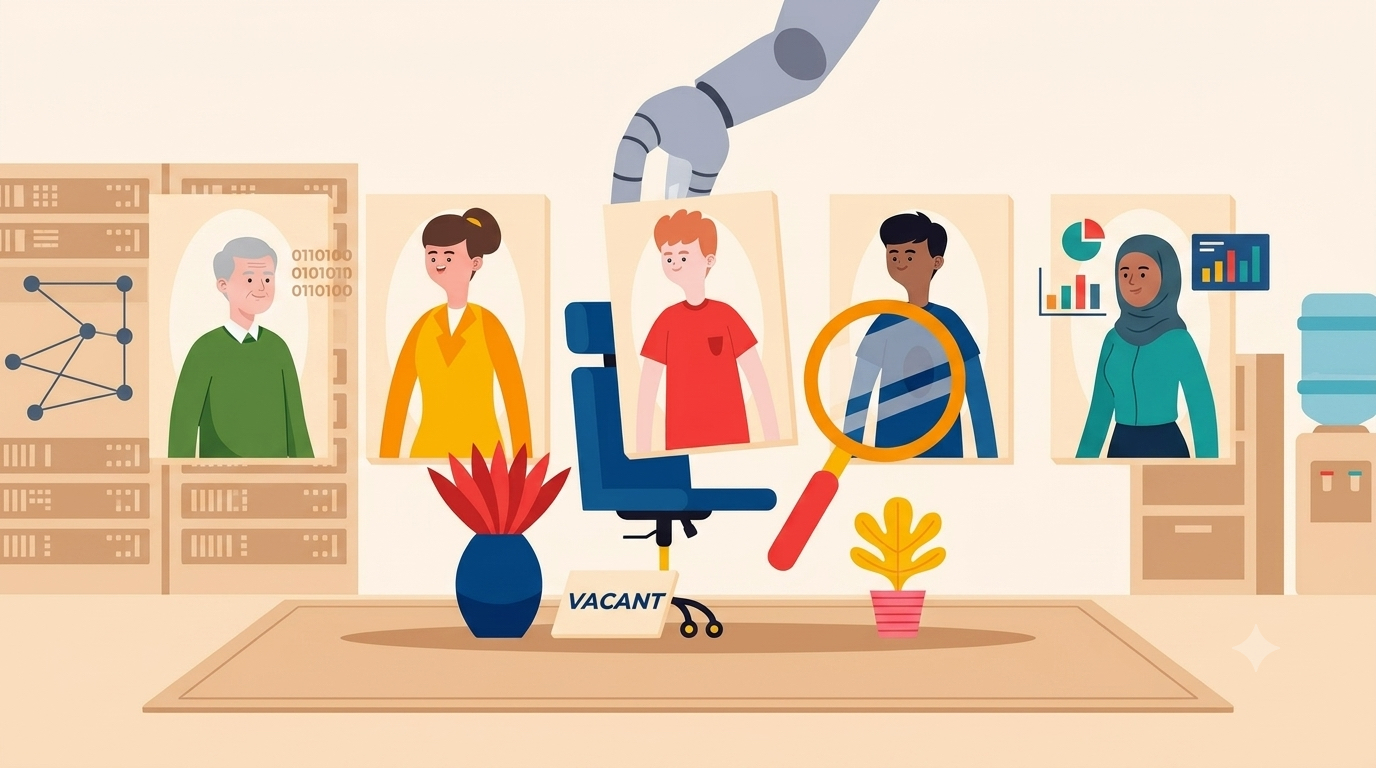
Many people have been concerned about the impacts of algorithmic bias in hiring for several years now. Unfortunately, progress to mitigate this bias has not kept pace with the adoption of AI tools by businesses. In some ways, the problem is becoming worse. As AI tools spread across recruiting, resume screening, and skill assessments, the risks are no longer hypothetical. They are becoming a routine part of how people access work opportunities.
Recognizing Our Era of Digital Inequity
The wider adoption of AI has, fortunately, brought more visibility to the issue of bias. Lawsuits, formal guidance, and emerging state regulations are now forcing companies to address the hiring risks that their use of AI has created. This is shifting the conversation from “Can AI discriminate?” to “Who is responsible for this discrimination?”

Percentage of companies that experienced cost decreed and revenue increase from generative AI adoption in HR by amount of change
Credit: The state of AI in early 2024, via McKinsey & Company
“A Computer Can Never Be Held Accountable…
AI companies and the employers that use AI to make or influence hiring decisions have tried hard to distance themselves from the negative effects of their actions. The accountability gap at the center of AI hiring allows employers to blame vendors. In turn, vendors say employers control implementation. AI might be marketed as objective, but automated systems reproduce and amplify discrimination when they are trained on biased historical data or used without meaningful oversight. AI use in HR continues to expand, with recruiting among the leading use cases. Many applicants may not know that the first “hiring manager” they meet now is not a person at all, but an algorithm.
AI systems do not need to explicitly use race, gender, age, or disability data to create discriminatory outcomes. Historical hiring data reflects historical workplace inequality, so an AI system trained on that data can end up subtly scaling the same exclusion. Resume screeners rely on data points such as names, ZIP codes, schools attended, and employment gaps to make decisions. These characteristics are not neutral; they are very common proxies to enable discrimination based on race, class, age, and gender, respectively. Video or voice-based tools can also evaluate speech patterns, tone, and facial expressions in ways that disadvantage qualified candidates with communicative disorders or neurodivergence.
Unfortunately for businesses, they are, in fact, responsible for the outcomes of their AI usage. Recent lawsuits show why this accountability matters. In 2023, iTutorGroup agreed to settle an EEOC lawsuit alleging that its hiring software automatically rejected older applicants.
The Workday lawsuit raises an even larger question of who is responsible when an AI hiring platform allegedly screens out applicants based on protected characteristics. Legal analysts describe it as a bellwether case that tests whether a hiring technology vendor can be treated as an “agent” performing hiring functions for employers.
Formal consequences are also expanding beyond individual lawsuits; there are now AI-Specific state and municipal hiring laws. States such as New York, California, Illinois, and Colorado have introduced laws that require notice when automation is used, extend anti‑discrimination protections to automated systems, and regulate AI‑driven decisions in areas such as employment.
…Therefore A Computer Must Never Make a Management Decision.” – IBM
If AI is going to remain part of hiring, companies must take responsibility for the systems they deploy. That means testing tools for unequal impact, requiring transparency from vendors, notifying applicants when AI is used and offering accessible alternatives, and keeping humans meaningfully involved in hiring decisions. AI can support hiring, but it should not become a shield for discrimination. The future of AI in recruitment depends on companies’ willingness to be accountable for its consequences.

Credit: DC Studio via Magnific
This article was written by a guest contributor, G. Johnson.

Everyone is welcome! We offer DEI programs tailored to meet the needs of all experience levels—find out more about our workshops here.